
Forever Young
New York/September 5, 1983
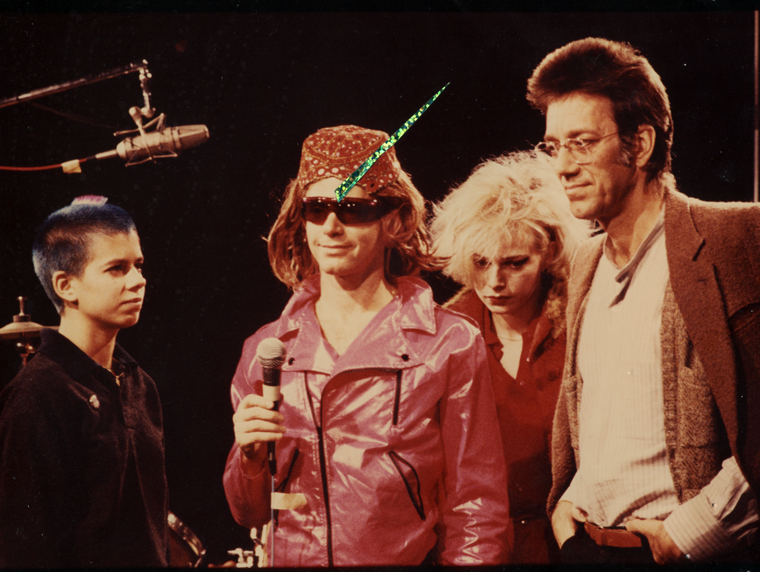
Peter Ivers was a legend in the making –a Peter Pan out of Harvard who wrote and performed his own songs and was a pioneer of New Wave video. But most of all he was a free spirit who tried to live the ingenuous ideals of the sixties in the eighties. His unsolved murder, last spring, cut short an extraordinary life and a career just reaching its promise. Two blocks to the east are the tacky bars and run-down transient hotels of L.A.’s skid row. The surrounding area looks like an urban desert –huge asphalt parking lots, several wholesale supply outlets, a couple of Japanese restaurants. The spacious loft itself, on the sixth floor of a commercial building, was sparsely furnished: exercise mats, a piano, some video equipment, a small refrigerator that had never been plugged in, two portable metal closets, and a mattress atop a wood bed. It was there, shortly after 2:30 P.M. on March 3, that Peter Ivers was found bludgeoned to death in his bed. There were no signs of struggle. At first glance, it seemed like yet another tale about a talented child of the sixties gone astray –a Harvard legend who had descended into a world of decadence and despair. Quite the contrary was true, but Peter himself might have appreciated the misapprehension. He always delighted in confounding people. Ivers majored in classics at Harvard, knew Latin and Greek, and could write Sanskrit, but that was just one of his personas. He was also a virtuoso blues harmonica player; a black belt in karate; a Yoga master who meditated up to two hours a day; the host of a national cable TV show devoted to New Wave music; an experimental video producer; a composer who had to his credit perhaps 100 songs, three albums and scores for a dozen films and shows; and a performer who had played avant-garde jazz at Lincoln Center and once served as the opening act for Fleetwood Mac. For all that, Peter Ivers, at 36 had earned relatively little mainstream recognition. But he had held on to both his idealism and his exuberance, remained true to values that may in his generation had long since abandoned. Most of his friends had earned more money and renown, but any had also become jaded and cynical. And for several of them the cost of success had been catastrophic. Tow and a half years before, peter had gone to the funeral of his best friend, Doug Kenney, 33, who either fell or walked off a cliff in Hawaii. Co-founder of National Lampoon, co-writer of Animal House, and a multi-millionaire, Kenney had had a prodigious cocaine habit and painful insecurities about his work. Eighteen months after Kenney’s death, many of the same friends gathered for the funeral of John Belushi, who had died of a drug overdose. “Peter”, says actress Kathryn Walker, a friend of all three men, “was truly high on life. Doug and John were high on everything but.” For Ivers, creating and collaborating were their own rewards, and making money remained secondary. He genuinely believed that the creative process kept people open-minded and alive, and so made the world a better place. “A lot of people in his generation got so caught up by that things they were protesting against that they never decided what they were for,” says Martina Horner, the president of Radcliffe, to which Ivers returned in 1981 as an artist in residence. “Peter knew what he was for, and he kept moving toward that goal.” For better and finally for worse, Ivers disdained security and throve on experimentation. That could mean hanging out at New Wave clubs at 4 A.M.; sitting at 4 P.M. in a steam room full of old Jewish men at the Pico Baths; taking a Bible-study class or teaching yoga; listening to blues, or jazz, or Irish folk music; juggling a dozen different collaborative projects; asking purposely provocative questions to the nihilistic punk-rockers who appeared on his cable show; or gathering a dozen disparate musicians on the roof of his loft building on a Sunday morning for an experimental-music-and-video project. Because Ivers had extraordinary powers of concentration, he became expert very quickly in the areas that attracted him. And because he was unselfconsciously open to new experience, he was welcomed in the worlds he explored – whether by black blues musicians or by old Harvard friends who had gone into the business world. And perhaps nothing pleased peter so much as bringing all these scenes together: At Harvard, he played blues harmonica for guests after a formal dinner at Matina Horner’s house; to L.A.’s wildest underground clubs he took his straightest friends. Peter and the Wolfe’s was a nightclub that catered to New York’s elite fancy dans and chorus girls and winos off the street and at 4 A.M. I’d play the latest music with a beat. -Peter Ivers “Peter and the Wolfe’s,” 1976 But Peter’s ingenuous idealism and his fearless experimentation had a flip side: the childish conviction that he would be protected from the responsibilities of adult life. Partly it was the way he looked. He was five feet five and trim, with a youthful, open face. But it was also his upbringing. His mother had been unusually supportive, and unusually tolerant too. At Harvard, Peter enjoyed more nurturing and indulgence: The members of his arty crowd were mutual mythmakers, encouraging one another’s belief that they were uniquely creative and deserved special treatment. As his friends grew up, their goals became less exalted and more practical. But they continued to applaud—even to romanticize—the fierceness of Peter’s dedication to his ideals, perhaps in part to ease their own guilt. “He became for us a kind of crazy barometer of integrity,” Tim Hunter, a college friend and now a movie director, said at the funeral. “Our shared secret, as Peter worked for acceptance and fame, is that we didn’t want him to compromise.” And for more than twelve years, Peter’s girlfriend, Lucy Fisher, now a senior vice-president at Warner Bros., supported him unwaveringly. But as she, too, grew up and became more visibly successful than Peter, she began to have some visions of her own. One of them was a family and amore conventional life than peter was prepared to offer. At times Ivers seemed to rebel for the sake of rebelling. Often, for example those of his songs that friends liked best would end up on his records in less listenable versions. It was as if he equated all commercial success and recognition with selling out—as he believed his stepfather had done. It was easy to see Peter as a narcissist whose experimentation was an excuse to act like a naughty little boy. But those who came to know him were usually willing to overlook his childishness, because Peter was so exciting and enjoyable to be around. They also came to admire his courage—the capacity to go his own way, even when there wasn’t any evidence he would be rewarded in the end. Ironically, in the final months of his life, Peter seemed to be finding a way to have the best of both worlds: to make a living without sacrificing his ideals. The promise seemed especially close—and his ambivalence especially vivid—on the last day of his life. When he awoke, shortly before 9 a.m., on Wednesday, March 2, it was pouring rain. Peter had spent much of the previous night making a demo tape of a new song and had fallen asleep, as he often did, in his clothes. Already running behind for a 10 a.m. meeting in Hollywood, he reached into his pocket and discovered that his wallet was missing. Convinced that he’d left it at a nearby Japanese restaurant the night before, he returned to check. No one had seen it, and for the next hour he retraced his steps without success. That evening, he would tell a friend that he was certain losing the wallet reflected his ambivalence about making money. As long as people didn’t give him money, he explained, he remained in control. “Money was always Paul’s god,” says Merle Ivers of her second husband from whom she is now separated. She met Paul Ivers in 1950, a year after the death of her first husband. Merle was 27 years old, Peter was 3, and his younger sister Ricki, was barely eighteen months. When Merle married Paul, a year later, he adopted both of her children. At the time, he was “retired”, having made a lot of money in the wholesale textile business. With a family to support, he went back to work, this time in the wholesale shirt business. Once again he did very well. He moved the family to a house in the affluent Boston suburb of Brookline, and each year he traded in his Cadillac for a new one. His attitude toward money was typical of a Depression kid. “I wanted my family to have what I hadn’t and I saw myself as the means,” he says. “All I knew was how to earn, and I was willing to work seven days a week.” Merle traces the beginning of Peter’s conflict with his father to the sixth grade. He’d just been accepted to Roxbury Latin, perhaps the city’s best private school. Also, his I.Q. had been tested as part of a Harvard research study, and it showed up in the genius range. “In Paul’s mind,” she says, “a genius performed in a certain manner, got A’s, became perfect. But Peter was never a prototype.” Paul doesn’t dispute that view. “I was selfish,” he says. “I was blinded by my desires for Peter’s great success in life.” To Paul, that meant choosing a professional career that would be both lucrative and prestigious. Merle’s approach was nearly the opposite. When Peter came home from Roxbury Latin with several C’s, Merle asked, “Pete, honey, why only C’s?” “Ma,” he replied, “the fact that I didn’t’ get an A doesn’t mean I haven’t absorbed what interested me.” That was good enough for Merle, and Peter’s passions grew, particularly for classics. But her attitude continued to rankle Paul. “Merle overlooked many faults in Peter, and this bothered me,” he remembers. The rift widened after Peter left for college. His acceptance to Harvard was at first the fulfillment of Paul’s most cherished dream. But soon he was having doubts. “When I went to visit peter in his dorm, his room was a shambles,” Paul remembers. “It was rather revolting to me. I lived in a home where everything was perfect, no ifs ands, or buts. I guess I just couldn’t take it.” At Harvard, Peter’s academic career soon took a backseat to other interests. During high school, he’d become a skilled technical director, and he began to get involved at the Loeb Theater, the center of Harvard’s drama scene. The prodigy of that era was a student named Tim Mayer—intimidatingly articulate, exceptionally well educated, and abrasively full of himself in the way only an arrogant young artist at Harvard can be. Mayer, who most recently collaborated on the book for My One and Only, remembers vividly the first time he met Ivers. “I was crossing the stage of the Loeb when I saw this elfin figure with a beard. He said to me, ‘You’re Mayer, aren’t you?’ I nodded, and he said, ‘I heard about you. Yore good, real good.’ Then he paused and said, ‘I’m Ivers. I’m the best…tech director in town.’” It was a myth made in heaven; Mayer and Ivers became inseparable, first as friends, then as collaborators. During his sophomore year, Peter mentioned to Merle that he’d like to learn an instrument; until then he hadn’t shown much interest in music. “He said he wanted to try something portable,” Merle recalls, “and that he knew a guy who played terrific harmonica and was willing to teach him. The next thing I knew he was a virtuoso.” Soon, Peter began to write scores for the musicals that Tim Mayer directed, and to play in local rock bands. The best known was the Street Choir, which was featured in Vogue spread in 1967, while Peter was still in college. Among its embers was Gil Moses, a black musician who went on to direct Roots and the stage version of The Wiz. “Peter was already one of the best harp players in the country,” says Moses. “He was gutsy and muscular, and he listened to every blues-harmonica player on record.” He also had a remarkable capacity to elicit a human sound from the harmonica. To those who remember Peter from that period, he was the epitome of sixties hip, oozing cool and confidence. Some who knew him found it all precious and off-putting. But for Chris Hart, a college friend and the son of playwright Moss Hart and Kitty Carlisle Hart, the proof of Peter’s power came when the members of Hasty Pudding—Harvard’s satirical drama club—traveled to Bermuda to put on a show. Peter had come along to do the lighting. One night the whole group—urged on by Peter—found themselves in a black club at midnight, listening to black rock-‘n-roll band. Midway through the set, Peter walked over and asked if he might it in and jam with them for a few tunes. The leader shrugged and said sure. “It was like a scene from on of those Fred Astaire-Ginger Rogers movies where everyone starts clearing the floor and suddenly it’s just the two of them in the middle,” remembers Hart. “No one was interested in dancing anymore. Everyone was just listening to Peter play the harmonica. Until then, I’d just thought of him as a little guy with a squeaky voice who hung the lights. But onstage he delivered a whole different personality, a little dangerous, much more commanding, and very sexual. When he finished, it was like we’d been heralded into the inner sanctum. He’d made it, and because we were with him, we all came along for the ride.” Several years later, when J. Anthony Lukas wrote a book about the student movement, Don’t Shoot—We are Your Children, he quoted a letter that one of the black leaders at Harvard had written to his parents, talking about eh first white friend he ever made: “He played the hippest harmonica you’d ever want to hear. That’s giving praises to a white boy, but Peter was heavy.” By the time Peter had given up on his wallet and driven to Hollywood, he was an hour late for a meeting to discuss an idea for a movie musical based on “Rock Around the Clock.” Peter had brought together an unlikely pair; Alan Sterne, a low-key, easygoing producer with very middle-of-the-road credits, and David Jove, the bright, belligerent producer of New Wave Theater, on which Peter served as host. The fate of Peter’s wallet dominated conversation at the meeting. At 12:30, Sterne brought the discussion to an end. “I gotta go,” he said. “Next time, let’s meet on time and get something accomplished.” As Sterne was leaving, he asked Ivers if he needed to borrow any money. Peter, always sheepish about his financial problems, said he did not. He’d just handed in the treatment for a screenplay titled City of Tomorrow that he’d done with his friend Rod Taylor for Warner Bros. Its story, based loosely on Alexander the Great, was set in the future and told the tale of a gang of teenagers who take on the evil adults and emerge victorious. Peter told Sterne he was due to pick up half of his payment, a check for $7,500, that very day. He met Lucy Fisher in 1969. She was a sophomore at Radcliffe, and Peter had just graduated. Lucy grew up in Englewood, New Jersey, the oldest of three children in a family Peter described as “aristocracy.” What he really meant was that they seemed so much more sophisticated than his family. Lucy’s father had gone to Dartmouth, her mother to Wellesley, and there were a lot of books in their house. In fact her father was a moderately successful steel merchant, and the family lived only comfortably. Lucy was never quite a goody-goody, but she was dutiful and eager to please. At Dwight, the private girls’ school she attended, she was elected president of the political-affairs club, was voted “most intellectual,” and earned top grades. Even so, she saw herself as a “sensitive young bohemian” who read poetry, listened to Bob Dylan, and spent Saturday mornings tutoring a young black kid on the other side of town. The one thing she lacked was a social life. All that changed in college. “I was immediately very popular,” she remembers. “Suddenly my looks were in style. I was very skinny, I didn’t have big breasts, and I had a poetic side.” When she met Peter, Lucy was still searching for a clear identity. His was so strong that for years she remained willing to live in his reflected glory. “The first time I say Peter, he was with Tim Mayer,” Lucy remembers. “He was wearing a leather jacket and looked scruffy, unshaven, and rebellious. His hair was dirty, and he was dressed terribly. I was smitten.” Even then, Peter enjoyed outraging people and attracting attention. He loved to take his clothes off, and even held one recording session in the nude. He was liable, in the midst of conversation, to break into a karate pose; to begin crying suddenly, which he could do at will; or simply to ask a startlingly direct question. Not surprisingly, people meeting Peter for the first time frequently found him intimidating, or obnoxious, or simply weird. Those who knew Peter saw method in his madness, even if that didn’t make it more endearing. “Peter created himself very self consciously,” says Jody Uttal, one of Lucy’s oldest friends. “He was a very clever marketer, and he would constantly invent new images for himself.” To other friends, the outrageousness was part of what made Peter different—and special. “He always wanted to test the true mettle of those he met,” says Matina Horner. “His provacativeness was his way of breaking down barriers. He wanted to see whether people could get beyond superficial appearances.” To those who did, Peter could be exceptionally loyal and supportive. “From the start, he acted like I made the best art in the world,” says Ilene Segalove, and experimental-video artist. “He also bough some of my work, even though I know he didn’t have much money.” When Peter began collaborating with Franne Golde on pop songs, he also became her biggest booster. “He was very sensitive to my moods,” she says, and especially to when I was down.” It was Peter’s instinct to encourage his friends, but it also became part of his artistic ethic. That was why he called his fledgling production company Advance Artists. Rod Taylor, speaking at Peter’s funeral, captured the feeling of many friends when he said, “He actually joyed in the success of others. When you were with Peter, you became the best and highest version of yourself.” By late spring in 1969, Lucy and Peter were seeing each other more frequently. But Peter also had his first big break—a record deal with Epic—and he was spending a lot of time in New York, recording his first album. At the time, Peter’s fantasy was that the record would turn him into a big rock star. After Knight of the Blue Communion came out, at the end of 1969, he told a local interviewer that one of his main ambitions was to give his father $500,000—“so that he’ll know I didn’t waste any time at Harvard.” To Tim Mayer the sentiment was familiar: “A lot of people were looking at the time for two-way bangers,” he says, “something that would reward them with money and fame for being exactly what a father might regard as a bum. Rock was the avenue Peter took.” But Knight of the Blue Communion was scarcely a commercial success. The songs that Peter composed and jazz artist Yolande Bavan sang, a blend of blues, jazz, and rock, won some critical raves. But the music was overly complicated and not particularly melodic. And Tim Mayer’s lyrics, written when he was suffering from an illness that was expected to be terminal, were predictably downbeat. But even when the record received little radio airplay and sold poorly, Peter didn’t dwell on it. He was already working on a new album, he continued to perform with several rock and jazz groups, and he’d begun the score for a new Tim Mayer production, Jesus, A Passion Play, which would end up on public television. After leaving Jove and Sterne, Peter drove to Peter Rafelson’s house, in West Hollywood. Son of director Bob Rafelson, Peter is a 22-year old musician; Ivers had come by to continue working with him on a song they had begun writing earlier that week along with Franne Golde. After listening to a tape of the new song, Ivers invited Rafelson to accompany him on some errands. The first stop was the William Morris Agency, to pick up an advance on the Warner Bros. Check. Most of the $7,500 was already committed to pay debts, so when he stopped off to deposit the check, he kept just $45 in cash. Then he insisted on treating Rafelson to lunch, and they decided to go to the Café Figaro, a trendy spot on Melrose Avenue. Back in the car, Ivers was in high spirits, “We’re doing it,” he old Rafelson. “F--- ‘em all. It’s been too long, but we deserve what we’re getting. We’re going to the top.” Rafelson asked him about Lucy, and Peter pointed out an expensive restaurant that they were passing just then, La Toque, and said that he’d been there with Lucy once, that it was very good, but that he hadn’t like the formality. Lucy and he were so different, he said; as a movie executive, her life-style was moving in a different direction from his. Even so, they weren’t really apart, and he still respected her a great deal. They’d come a long way together, he said, that was for certain. Ivers went to California for the first time in the spring of 1971. Epic had rejected his second album as too esoteric. Tim Hunter, his college classmate, was on a fellowship to the American Film Institute and invited Peter out to score his film. Soon he was doing scores for other young directors. Lucy came to visit twice, but when she wasn’t able to find a job she went back to New Jersey. Her father had died the year before, and she moved in with her mother and got a job writing book-jacket copy for Prentice-Hall. She didn’t like it. Peter had moved into the Tropicana, a motel frequented by rock-‘n-rollers that was just raffish enough to suit him. Equipped with a brash business card—“Peter Ivers: Music for Cash”—he began moving in music circles. The key introductions were to Van Dyke Parks, a quirky musical talent and onetime Beach Boys collaborator, and Linda Perry, a rising and well-connected young independent producer. Charmed by Peter and moved by his talent, they took him to Lenny Waronker, a top producer at Warner Bros. Both Waronker and Mo Ostin, head of Warner Bros., were impressed. They liked the mix of his primitive blues sense and his more educated musical instincts. Warner gave him an extraordinary advance—more than $100,000. To produce the record, Ivers hired his friend Buell Neidlinger; a much-admired bassist who had been a member of the Boston Symphony and had also played avant-garde jazz with Cecil Taylor. By then, Peter was writing both music and words for his songs, and his wry lyrics blended innocent romance with a slightly darker streak. “Terminal Love,” which became the title song of the new album, begins, “Every time you attack your heart/Your heart will attack you…your vital parts’ll defeat you/Your heart is gonna beat you.” “Alpha Centauri,” a dreamy version of getting lost in space, was actually written to Lucy when she went away on a vacation: “Since you been out of town/The machines broke down/Slippin way out of phase/Drifting light years away…Since you been out of town/the supply’s all gone/You gotta come back/With my energy pack.” When work began on Terminal Love, Peter was still talking buoyantly about rock stardom. Recoding took six months, and by the end Peter had pretty much ensured a commercial failure. He’d chosen to sing on the record himself, and his high-pitched, nasal voice, though oddly affecting, was hardly mellifluous—“like Howling Wolf if he inhaled helium,” as Peter described it. And then there were the songs. “Peter had his own forms,” says Neidlinger, “but no idea what ‘commercial’ was. His music was quite a bit too complex for a mass audience.” David Fisher, Lucy’s brother and one of Peter’s most ardent admirers, puts it another way: “the more he produced, the less good it sounded. The first time, on tape, it would just be him on harmonica, with maybe an electric piano. There was something simple and beautiful about it. Then on the record there would be a twelve-piece band and four backup singers, and the feeling of Peter would be lost.” Lucy, meanwhile, had returned to California, and she and Peter had moved into a small house in Laurel Canyon. After working at odd jobs for two years, she got her first break—reading scripts free-lance for United Artists—about the same time Terminal Love was released in 1974. Peter moved on to a new album; even after Terminal Love died in the record stores, Warner decided to give him one more chance. But Peter still couldn’t, or wouldn’t, write accessible songs, and The Peter Peter Ivers Band became his third flop. Shortly after the album was released, in mid-1976, Fleetwood Mac invited Peter to be its opening act for a sold-out three-night stand at Los Angeles’s Universal Amphitheatre. Some friends say it was at the Fleetwood Mac concerts that Peter performed in an oversize diaper. Lucy is certain he wore the diaper to another performance. But everyone agrees that Peter was not a hit. A squeaky voice, complex arrangements, and whimsically ironic lyrics were more than Fleetwood Mac fans had bargained for. Nor did he make any attempt to meet the audience on a middle ground. When he got down on his knees to sing “Peter, why can’t you stay with me tonight/Peter why can’t you hold me like I like?” many in the crowd booed. Actually, “Peter” was a wonderful self parody written in Lucy’s voice—but Peter never shared that with the crowd. If there was a single moment when his dream of being a rock star died, it was probably that night. After he’d dropped off Rafelson, Ivers drove to Studio 55, where Franne Golde had spent the day recording background vocals for “She’s My Kind,” a song she and Peter had written that was being recorded by Japanese rock star Junko Yagami. During the preceding several weeks, they’d learned that other songs they’d done were going to be recorded by Diana Ross, June Pointer, and Marty Balin. Listening to the Yagami version of their song, both of them got excited. “We’re happening,” Peter told Franne. “This is it.” Linda Perry, who was also there, remembers Peter’s wide-eyed look. “It amazed Peter that his work was being recognized commercially. He’d say to me, “Wow, people really seem to like it.’” The Fleetwood Mac fiasco scarcely dampened Peter’s ambition, but he began to focus more exclusively on his writing. “Peter had always worked all the time, but he became more obsessive,” Lucy remembers. “If we went to the beach, he couldn’t just relax; he’d pack an electric piano into the trunk in case inspiration struck.” Some friends, who found him most charismatic as a performer, were saddened by the career turn. “He would sit at a piano and sing a song or play his harmonica looking right at you, and he was incredibly sexy,” says one female friend. “It was very open seduction, but it was romantic and disarming, not threatening.” Peter recognized the irony. “My only problem,” he once told a friend, “is that I have to win y fans one at a time.” At the same time, peter became more resistant to anything commercial. He rejected a Warner Bros. Offer a high paying job as an in-house producer. Instead, the projects he undertook were mostly low-paying: a much praised score for David Lynch’s underground cult hit, Eraserhead, and another one for the low-budget Grand Theft Auto, Ron Howard’s directorial debut. Also, when he played gigs, he invariably paid his musicians more than he earned. “He had the samurai philosophy,” says Steve Martin, a friend and collaborator. “In any business transaction, you should get the worst end yourself.” But the result was that he began to rely more on Lucy financially. Some felt he was trying to have it both ways. “He would scoff at commercial work, but he didn’t have to support himself,” says Leslie Fuller, a friend. “It was Peter Pan-and –Wendy fable—they even referred to themselves that way. Peter was the magic boy; Lucy took care of him.” That wasn’t entirely true. In their early years together, when peter had made what4ever money they had, he paid most of the bills. But even Lucy acknowledges that for years, like Merle before her, she staunchly defended “Peter’s right to be Peter.” When friends came over, Peter would play his new songs, or the songs of his friends, and Lucy would spend hours listening. “Their relationship was very deep and physically affectionate,” says one of Lucy’s friends, “but it wasn’t very grown-up.” During one period, Peter refused to eat with any silverware at all—partly out of some childish impulse but also just to try something different and shocking. It worked. Even friends who indulged most of his idiosyncrasies found his primitive manners a bit much. Kathryn Walker, who’d been Doug Kenney’s girlfriend at his death, felt the same way about Peter. I think the bad-girl components in both of us were released by being attached to guys like Doug and Peter.” By 1977, as Peter was veering farther from the mainstream, Lucy was heading directly into it. She’d taken a job as a story editor for Sam Goldwyn Jr. and got to know most of the major players in the movie business. Now when Peter’s friends came over, Lucy often retired to the bedroom to read scripts. Peter was also filling his time with new interest, especially yoga and meditation. He was not by nature introspective, and meditation muted the conflicts he felt. “He hated the disapproving voice in his head,” says Lucy. “The way he saw it, his mind was trying to interfere with his well-being, and he was trying to cultivate control over what it could do to him.” Marijuana—the only drug he used—served the same role. “It dims the pain,” he would say. Many of his friends had long since moved on to more insidious drugs, chiefly cocaine. Mark Canton, a Warner executive, remembers when Peter visited Doug Kenney in Florida on the set of the movie Caddyshack. Enormous quantities of cocaine were reportedly being consumed on the set each day, but Peter had his agenda. The image Canton retains is of Peter sitting on the lawn of the Rolling Hills Golf Resort, teaching yoga to a dozen grips and cast members who had spontaneously gathered round. He also took up karate, not so much for its Eastern overtones or as a physical outlet but because he wanted to be able to defend himself. It took him only three years to earn his black belt, but then it was withheld for three months—on the ironic ground that he lacked “the fighting spirit.” For Peter was sympathetic to outcasts and oddballs, especially to those who called themselves artists. And because he was inclined to look for the best in people, he was also more vulnerable to charlatans. “Peter sometimes used inferior musicians,” says Buell Neidlinger. “He liked to help underdogs because he felt sorry for them, but they had nothing to give him.” That wasn’t quite so. By offering unconditional respect to people unaccustomed to any respect, peter inspired exceptional devotion. Some friends treated him almost as a guru, a role that he seemed to enjoy. “To be in Peter’s thrall,” says one person who found his guru persona off-putting “was to accept the image of Peter as a wise philosopher. He had a lot to offer, but he was a guru mostly to the timid.” Peter’s other interests certainly interfered with life at home. “He’d spend up to two hours a day on yoga and meditating,” Lucy says. “Meanwhile, I stayed later at work.” That became especially true in the spring of 1978, when she got her first studio job, at M-G-M. Lucy hadn’t yet launched any projects of her own, but she was bright and charming, and while she could be quite direct, it was in a girlish, unthreatening way. She was particularly effective with creative people. Accustomed to the artistic temperament, she was able to indulge its excesses. At M-G-M, Lucy helped to acquire two scripts: Fame, which became a modest critical and commercial success, and One From the Heart, Francis Coppoloa’s controversial disaster, whose production she would eventually oversee. After six months at the M-G-M job, Lucy got an even better offer—to be a vice president at Twentieth Century-Fox at a salary of $50,000, plus plenty of perks. Suddenly, without a major movie to her credit, Lucy became a “baby mogul.” Shortly after 8 p.m., while having dinner in Hollywood at the Marco, his favorite macrobiotic restaurant, Peter called Rod Taylor, his collaborator on City of Tomorrow, to tell him that Mark Canton had just read the treatment. Canton liked it and was going to take the next step and suggest that Warner commission a full screenplay. On submission, Peter stood to earn an additional $50,000. The troubles with Lucy had a bittersweet side. For in writing about the pain and the slow separation, Peter did some of his best and most powerful work. Wary of trying another album, he had begun to develop alternative ways to present his songs and ideas. Nirvana Cuba became the working title for a rock musical based on a series of new songs that traced the passions and disruptions of his relationship with Lucy. “Musically getting stronger,” says Gil Moses. “The Nirvana Cuba songs were a real expression of what he was going through. Some of them I loved, and others I felt were confused. But even then you loved Peter for stretching, for taking you to new places.” Much of his attention was focused on collaboration—particularly in the merging of video and music. “The Ivers Plan,” which he began conceiving in 1978 or so, became his artistic manifesto. “The idea,” he wrote, “is to produce high quality, mass-marketable video and audio works from low-budget underground sources…to market ‘off Broadway/off Hollywood’ of film and video, and market its high-energy, raw-talent artists in new video forms.” The new movement was inspired, Peter said, by record-company promotional tapes, video clips that illustrated their artists’ songs. It was a prescient reading of the public appetite. Several years later, MTV: Music Television was introduced using those very tapes, and it quickly became the hottest programming concept in years. Peter’s notion was to go a step farther. “We need long-form videos,” he wrote, “which tell a story through loosely connected songs and production numbers—videos that merge rock and Hollywood. The eternal dramatic values still apply, but the beat, the outrageous imagery, and the collaged sense of reality become the new visual vocabulary.” This was what he meant by “New Wave.” To do such work himself, he began to get some foundation support. In 1979, the Long Beach museum underwrote four video-and-music clips that evoked what the best MTV clips would three years later: exuberance, raw energy, stylish visual effects, and a sense of humor. “The Fan Club,” for instance, was a self-parody in which Peter was chased by hordes of adoring women as he sang, “I can’t stand the fans.” As it happened, he soon would really have some. In early 1980, Peter met David Jove, who was about to launch a local cable TV show aimed at showcasing the dozens of punk-rock bands springing up in Los Angeles. The night before the show went on, peter agreed to be the host. Of all the experimentation he’d done, mingling in this world was probably the most extreme. Bands with names like Slash, Fear, and Hollywood Trash included some very angry, self-destructive young performers—often without any discernible musical talent. But Peter was drawn to the freshness, the rawness, the rebelliousness, and the new musical ideas percolating among the best of the bands. New Wave Theater also allowed Peter to perform again. He took to dressing in fight wigs and masks, thin leather ties, two or three pairs of sunglasses. “My role is to be the provocateur,” he told an interviewer. “That’s why I wear glitter all the time. I know the punks hate it…[but] that’s how you create great theater, by testing the boundaries.” Gil Moses believes that Peter was expressing another feeling. “The problems with Lucy threw him into a tailspin. I think he didn’t feel whole, and he constructed another image, and androgynous one, at a time when he’d lost the underpinnings of his masculinity.” Not that he totally rejected his roots. When a punk showed up wearing a T-shirt of his alma mater, Peter said contemptuously, “You’re wearing a Harvard T-shirt, and yet you appear to be a total moron.” After New Wave Theater was picked up for national distribution by the USA Network, it began to achieve a cult status and brought Peter some of the fame that had long eluded him. Home Video magazine named Peter on of the top 25 cable stars the year after the show began, and he was undeniably engaging as host—at once mischievous, innocent, and exuberant. But New Wave Theater was putting even more distance between Peter and Lucy. He often worked into the middle of the night. She’d just become head of production for Francis Coppola’s new Zoetrope Studios and was leaving home early and returning late. Nor did Lucy much like the New Wave scene. “Peter began to invest me with his father’s disapproving side,” Lucy says. “I was getting to be ‘Mr. Management.’” When Peter and Lucy began to discuss buying a house in mid 1980—at Lucy’s urging—the financial imbalances in their relationship became an overt issue. Lucy had begun to think about having children, and that led to wondering about how they’d be able to meet the mortgage payments if she wanted to take time off from work to be a mother. “I’d denied it, but I realized the money thing was eroding his confidence and making me resentful,” Lucy says. “I loved Peter more than anything, but I also wanted to grow up and have a family.” In November, Lucy moved out of their Laurel Canyon house into one that Coppola owned and had offered to let her use. Peter and Lucy continued to talk everyday and see each other frequently. He got a great kick out of being invited to Harvard that fall to lecture on New Wave music an, three months later, to serve as an artist in residence with Tim Mayer at Radcliffe. Chris Hart, his college friend, was one of those who attended his original lecture in the fall of 1980. “It was a bizarre scene,” he remembers. “Peter started out wearing what looked to be a tweedy academic outfit and talking about technical things like the particular harmonics that characterize New Wave. But as he delved deeper into his subterranean world, he began to remove layers of clothes, and each one underneath was more far-out. Finally he got to the seventh layer, and when he peeled that off, he was wearing skintight sliver spandex tights and a cutout T-shirt with a slash painted on the back. Then he took out a harmonica and began to play. The crowd kept growing. It started at 20, and by the time they let him stop, there must have been 150 people listening.” It was precisely the spirit that Peter sought to capture in the more ambitious project he called Vitamin Pink Fantasy Revue. Like Nirvana Cuba, it grew out of songs that he’d written since Peter Peter Ives. The idea was to use them as the basis for a show that blended dance, music and street theater, and brought together both New Wave performers—most prominently a six-foot-tall black singer named Tequila Mockingbird—and several of his most commercially successful friends. Harold Ramis, who had directed Caddyshack, co-produced. To Peter Vitamin Pink was a surreal meeting of the aboveground and the underground, centered on two layers who journey to exotic locales like Iran, Vietnam, ancient Rome and using songs with titles like “Saigon Rainstorm” and “I Raged and You Ran.” To Harold Ramis, Vitamin Pink was really Peter’s autobiography. “The songs could be seen as a history of people who’d come out of the sixties radicalism, been dispersed and demoralized in the seventies, and emerged as the New Wave warriors of the eighties.” The model Ramis had in mind was Hair. “That was a show,” he explains, “which took something alien—hippies—and made them acceptable and popular. No one had yet tried to do the same for New Wave.” When Vitamin Pink was previewed at Club Lingerie, in Hollywood, for two nights in June of 1982, both performances were sold out. It had a half dozen musicians, an equal number of dancers, several singers, slick video effects, and colorful costumes. But there was no clear story line, and the audience—which included a number of potential investors—never quite knew what it was getting. “There were pearls, but they needed to be strung together into something,” says Gil Moses. The dilemma was a familiar one. Was Peter’s vision so pristine it was unalterable, or were his friends merely indulging his neurotic impulse to equate accessibility with selling out? “You can always satisfy the mass audience,” Peter had written, “By…giving them what they want.” But does that justify the reverse? “He just didn’t include the audience in Vitamin Pink,” says Alan Sterne, who worked on the show. “I think he resisted out of fear, not stupidity. Peter had an inability to go that last step.” Iver’s first real attempt to include the audience began when he met Franne Golde, a songwriter who had solid commercial credits. Linda Perry introduced them at the end of 1981, and the chemistry was instant. They smoked a little grass and wrote their first melody on the day they met. The friendship was equally important. Franne was effusive and sweet, and she became an anchor for Peter. “I was his Jewish mother,” she says. “I’d keep him nutritionally together, make sure he had gas in his car.” The second song they wrote, “Little Boy Sweet,” was recorded by June Pointer and is now part of the soundtrack for the hit film National Lampoon’s Vacation. The next three were picked up by other performers in the months that followed. He was pleased that his songs were selling, but he couldn’t resist minimizing the work, telling friends it was just a formula to be mastered. To Richard Greene, a musician friend, Peter explained that he was writing songs aimed at “a black, teenage, high school chick with a ghetto blaster.” In the summer of 1982, Peter moved to the loft downtown. A huge space in an ethnically mixed and decidedly unfashionable area, it fit his fantasy of how an artist should live. He was juggling a dozen projects at once, traveling in his beat-up Fiat from collaboration to collaboration. His friends became an extended family, and he kept in daily contact with perhaps two dozen of them—many in person, the rest by way of the beeper that linked him to the telephone answering machine in his loft. Toward the end of 1982, several of Peter’s friends noticed that he seemed more frenetic than ever about his career. One girlfriend, writing to Peter’s mother after his death, described a conversation she’d had with him around Christmas: “He said that the thing he missed [lately] was my reminding him to plan recreation time. Otherwise he was always working, with no time for play. Then he said something that seemed strange. He said he had so many things to do and felt he had so little time.” Lucy believed that he was doing it to prove something to her; she’d begun to get involved with another man. “I felt he was in a desperate race to get his stuff together,” she says. “We still loved each other, and we both always felt that if he became successful it might solve the problems between us.” At the end of 1982, ATV, the song publishing company where Linda Perry worked, offered Peter a songwriting contract. It held promise of some financial stability, as well as access to a sophisticated recording studio. But the negotiations were difficult. At first, Peter didn’t want to turn over rights to the music he considered his own—specifically Vitamin Pink and Nirvana Cuba. But by February he was telling Linda Perry that ATV might be able to help his other projects too. A contract was readied for Peter’s signature. The terms guaranteed him a modest, five figure sum against royalties for three years. It would have been the first regular salary he’d ever earned. After eating dinner at the Marco with one of his yoga teachers, Peter talked briefly to Lucy on the phone, promised to call again later, and then decided to drop in on his friends Howard and Barbara Smith. Howard is a film editor who worked frequently with Peter; Barbara is an associate director of Filmex, the annual L.A. film festival. “Peter seemed happy,” Barbara remembers. “He talked about his music publishing deal, and said it meant a lot, because he wouldn’t have to hustle so hard anymore. He also mentioned losing the wallet, and said it was a symbol of his ambivalence about money.” When Howard joined them, they all listened to some cuts from the new Randy Newman album, and then Peter played them some demos of new songs he’d written. Howard and Barbara were struck by Peter’s relative calm. Usually he leapt around the room, full of nervous energy. On this evening he was much more self-contained. He didn’t even phone home to check for messages. During the last week of February, peter called his mother to tell her that he was planning to come east in two weeks for his grandfather’s eightieth birthday. He also called his father. They’d been speaking more frequently, and Paul offered to pick him up at the airport. Peter said that wasn’t necessary; he’d be renting a car. The third person he called was Kim Brody, his girlfriend before Lucy and the only other serious romance in his life. They’d stayed in touch of the years and remained close. “He just wanted to talk,” Kim remembers. “He was kind of lonely, and he was reaching out. We were going to meet in New York when he came east. I felt he was trying to figure out his relationships. I’d just fallen in love myself, and he wanted to talk about that. He wanted what I had found.” Shortly after leaving the Smith’s, Peter called Lucy again. It was about 11 p.m. She’d read the treatment for City of Tomorrow and told him she thought it was a little dark but she liked it. He told her he’d made a new appointment to meet with his therapist that Sunday night. It had been his idea to sit down and talk about their relationship with a third person. Lucy, sick with mononucleosis, had been forced to cancel an appointment. Neither of them knew where the session would lead, but both agreed that things between them were not resolved. At 2:45 a.m., Peter called Laurie Riley, a woman he’d taken out earlier that week. He told her that he was at home, that he was going to meditate, and that he’d see her in the next couple of days. Everything was grooving on a Saturday night We were in our dress togas and looking right I was gonna put a move on this Daphne dame Insert the candle and light the flame But that fiery climax never came. -Peter Ivers “The Gladiators Attack the Aristocrats,” 1979 Anne Ramis became concerned when Peter didn’t return several of her calls on Thursday morning. At 2:30 p.m. she called Jim Tucker, who lived in the adjoining loft, and asked him to check on Peter. When Tucker turned back the covers, Peter was fully clothed. There was blood all over the sheets. The police took 45 minutes to arrive. They didn’t seal off the murder scene, and people wandered through the loft at will. The police theorized that a robber had entered the loft in the middle of the night, accidentally woken Peter up, and killed him, perhaps inadvertently, in an effort to keep him quiet. The evidence was circumstantial. Several pieces of video equipment were missing from the loft, the lock on the front door had been jimmied, and there had been several recent robberies in the building. Some of Peter’s friends—and a private detective Lucy hired—wondered if the killer may have known Peter, through New Wave Theater or the nighttime scene in which he moved. What seems clear is that by living in the neighborhood he did, with a cheap lock as his only protection, Ivers made himself a very vulnerable target. News of his death spread quickly, and by 6 p.m. nearly two dozen friends were gathered outside the loft. The funeral and main memorial service were held at the Leo Baeck Temple, in West Los Angeles, on Sunday. More than 300 people attended. Paul Ivers was not among them, nor did he offer to pay for any of the arrangements. Alan Finger, Peter’s yoga teacher, held a separate service and meditation at his yoga center that same morning. David Jove organized a third memorial at the New Wave Club at Sunset. Condolence letters from New Wave Theater fans arrived from cities including Chesterfield, Indiana, and Stillwater, Oklahoma. A week after the murder, 100 of Peter’s East Coast friends gathered in New York at Chris Hart’s mother’s apartment. And in May, at the fifteenth reunion of his Harvard class, there was another memorial—this one mostly a concert of his music and videos. It was also announced that scholarship fund in his name to support burgeoning artists at Harvard, had already attracted $65,000—half of it in matching funds put up by Warner Communications. A year before his death, and interviewer for a book called The American bachelors Register had asked Peter where he would choose to live if practicality were not constraint. “In the hearts of the people,” he’d answered. On July 21, Diana Ross gave a free concert for 350,000 people in Central Park. As the rain began to come down, she introduced a song Franne and Peter had written for her latest album. It’s called “Let’s Go Up,” and the chorus goes like this: Let’s go up Forget about down Cause in this town It’s gonna get rough But what goes down Is up to us So let’s go up.
I found this tribute on David Jove's website, a New Yorker article.
Lord God Love by Peter Ivers
Tribute to Peter Ivers
mslindascott@yahoo.com
.